
Bradul
logo

typography
Titles – IBM Plex Mono
Copy/body text – Roboto
colors

destination
Graphic design for online purposes.
Number of deliverables: 1 infographic, 3 info-cards, 1 animated clip.
brief
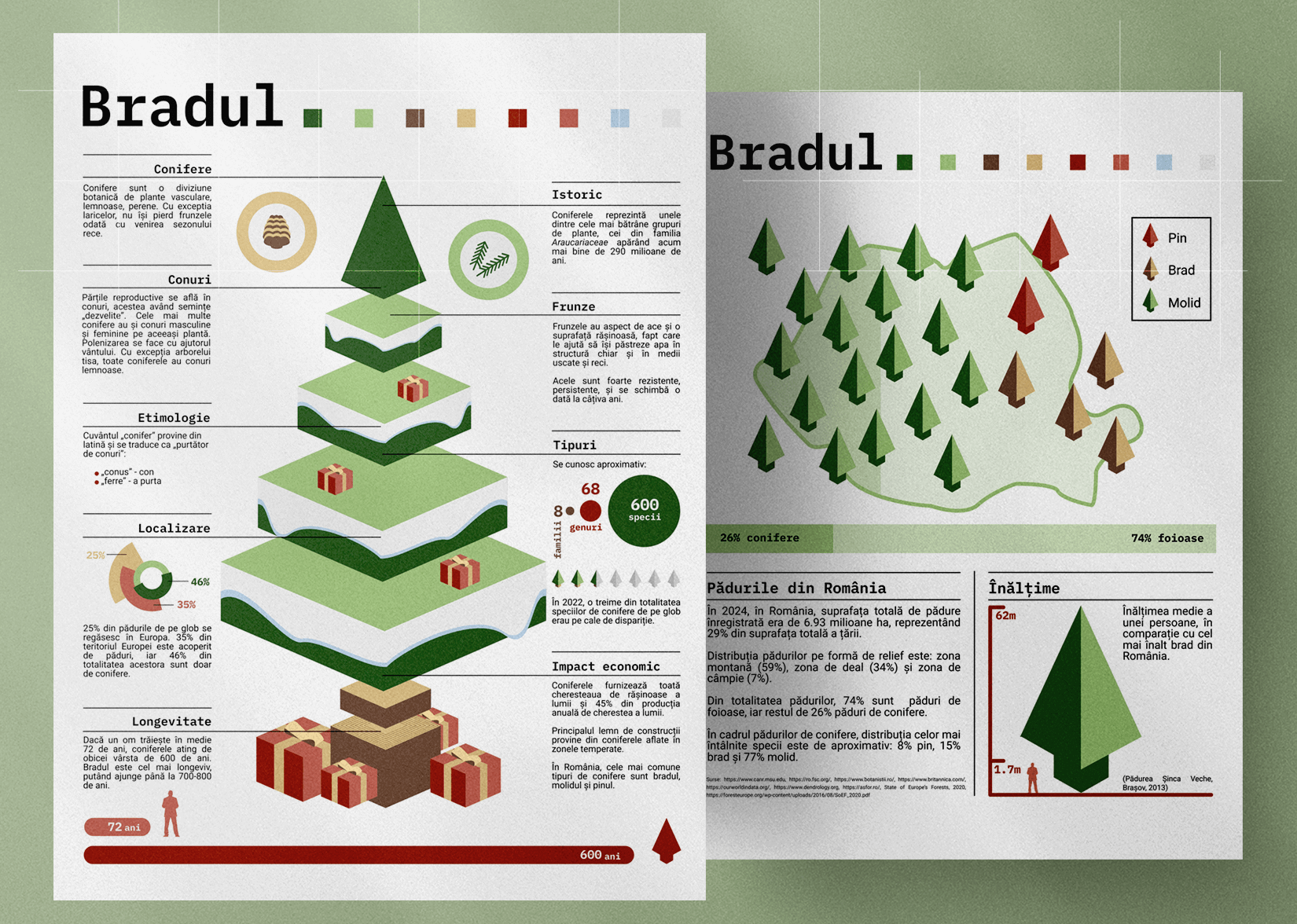
We were determined that in 2025 our Christmas would be different. That meant coming back to our inner selves and preparing to end the year. On top of that, we also wished to share with our public a little nugget of knowledge. And as we know, on Christmas, one of the core elements is the Christmas tree, we put together an infographic with general knowledge bits about conifers.
We didn’t go too much into detail, but we focused on aspects that concern the structure of conifers, their types and distribution, as well as what the situation in Romania looks like.
As a main goal, we wished to publish it digitally, in its entirety, on our website. But we also made a few info-cards which we shared on our social media (Instagram, Facebook și LinkedIn).
The project will be accompanied by an animated clip, which is meant to present the information in a faster and more accessible way.
All the data used in the making of the materials at hand come from public sources and can be accessed below:
- Michigan State University, Christmas trees and the science behind them
- State of Europe’s Forests, 2020
- Descoperă.ro, Cel mai înalt brad din România
- Forest Stewardship Council, Pădurile din România – scurtă introducere
- International Dendrology Society, Pinaceae
approach
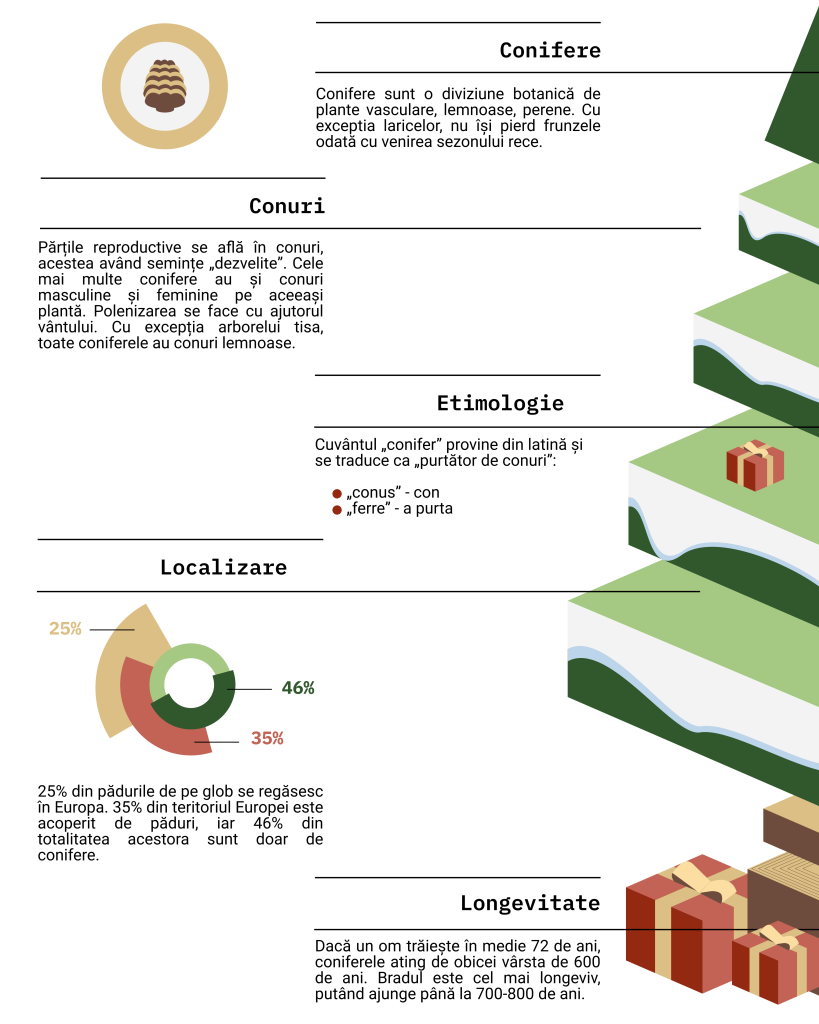
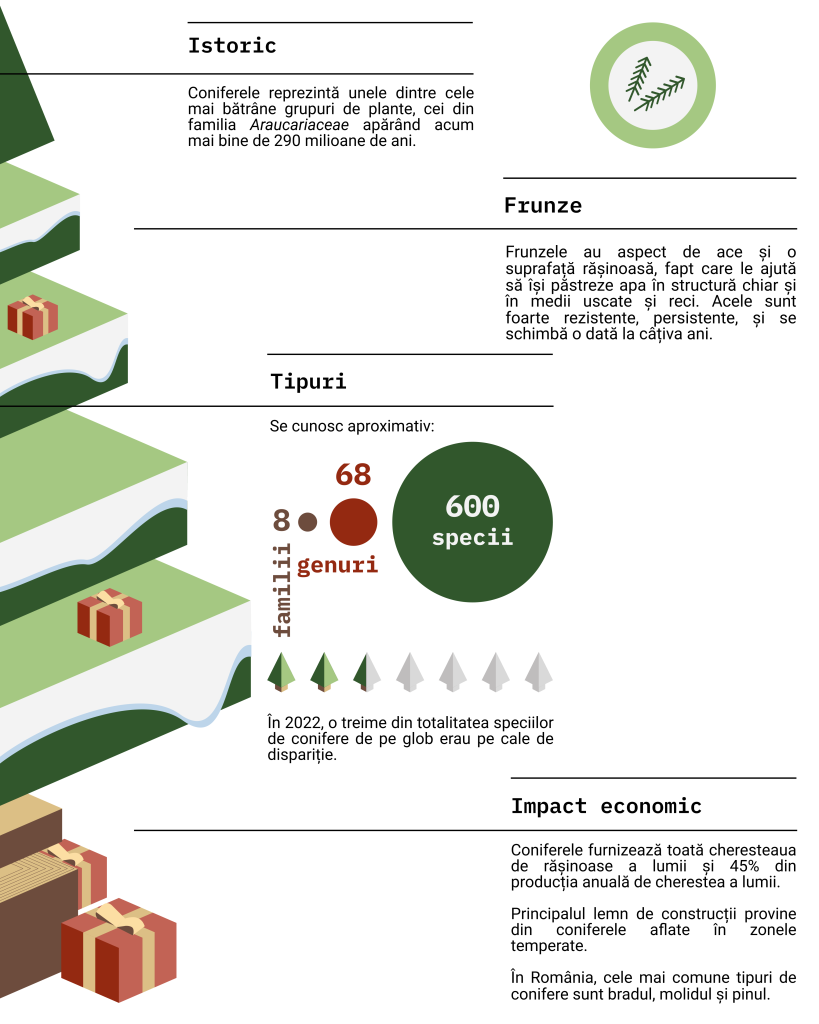
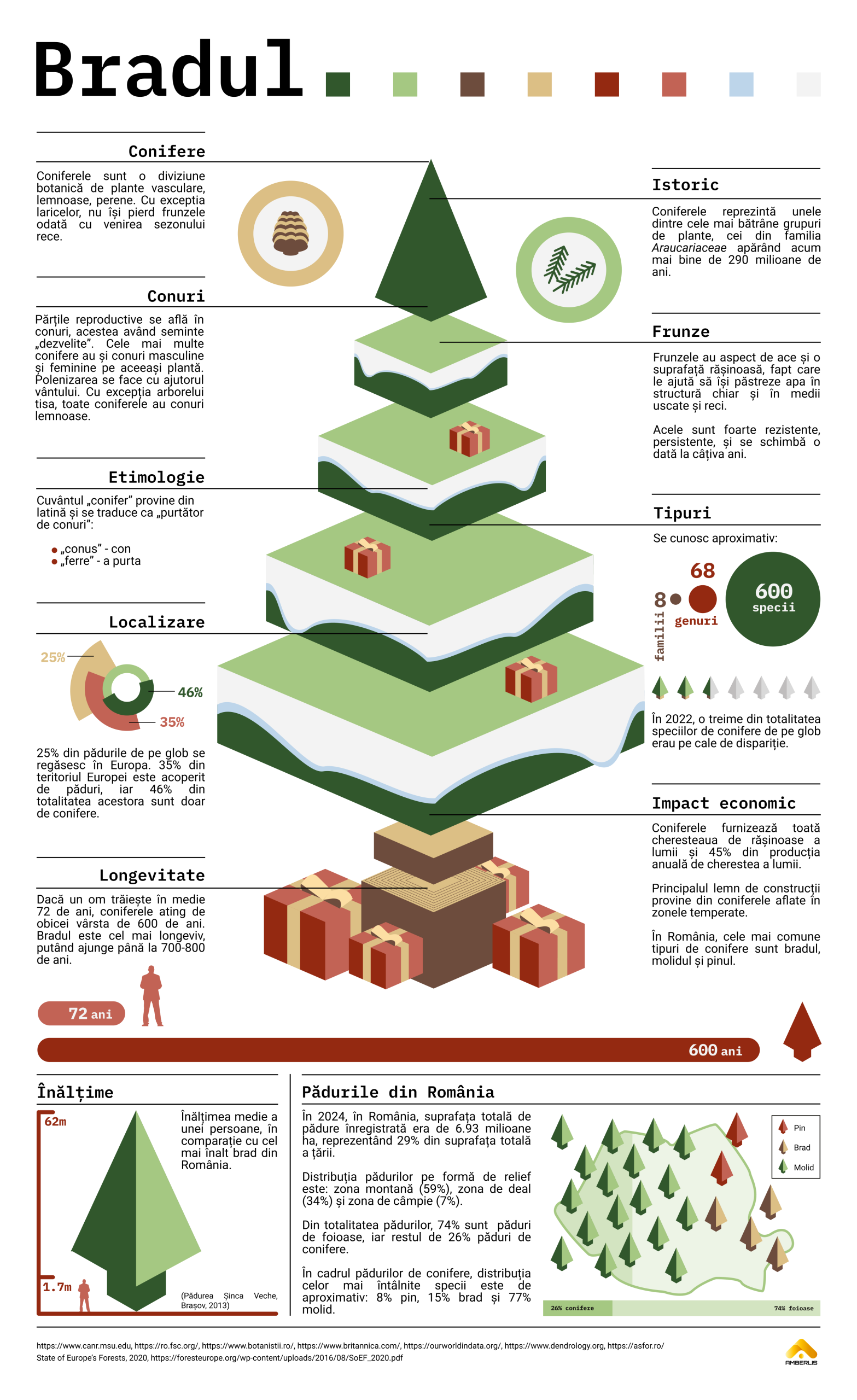
We started our story with aspects that focus on the history and biology of conifers, when they appeared, and what particularities characterize them. We graphically represented the cones and needles because they are two of the most defining characteristics that set them apart from other trees. We researched how many species there are and into which families they are divided. We chose a simple visual representation that puts into perspective the size of conifers. Because they are families with a number of subgenera and species, we looked up their distribution in the world, and we found that almost half (46%) of all forests in Europe are coniferous.
Some coniferous species appeared more than 290 years ago. But how long do they live, on average? Answers vary depending on the species, but they can often reach 600 years of age. For example, fir trees are some of the longest-lived conifers, reaching up to 700-800 years (in contrast with the average human lifespan of around 72 years).
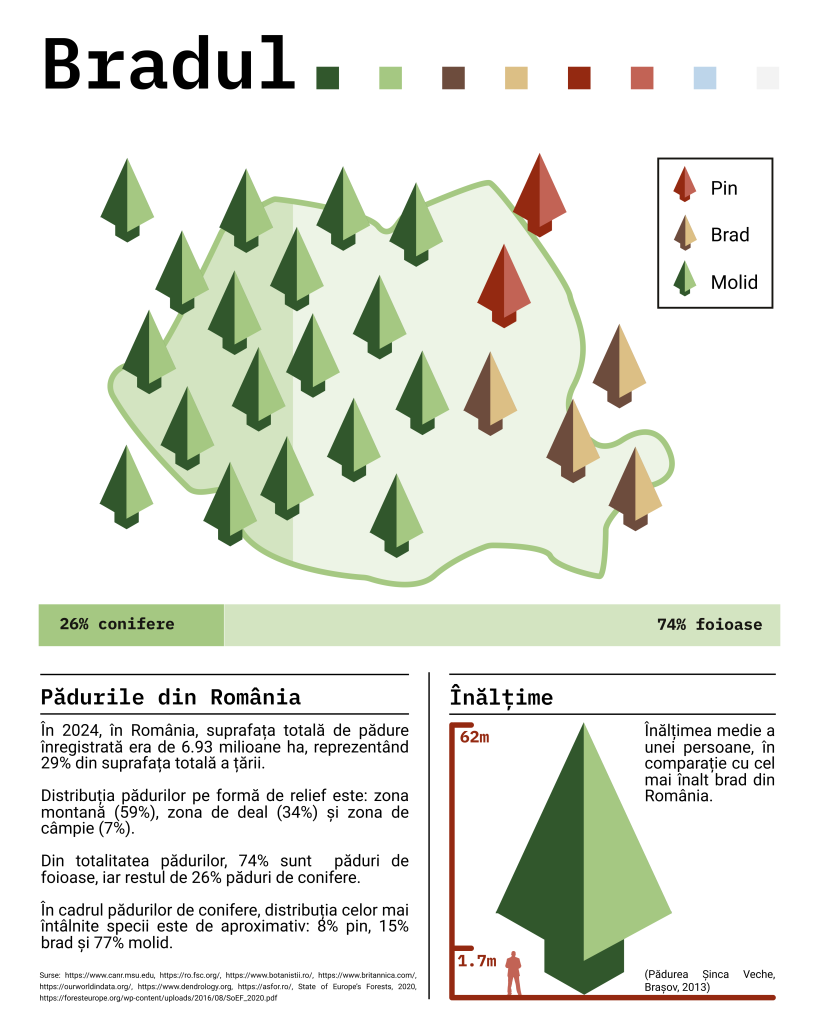
Given that we compared their longevity with that of people, we though to also compare their height in the same way. We looked up the tallest fir tree in Romania and we discovered it has up to 62m, and was found in Pădurea Șinca Veche in Brașov in 2013. Almost twice the size of a 10 floor building. Comparatively, a human is approximately 26 times shorter than this fir tree (average human height is 1.7m).
Close to 29% of Romania’s surface is covered in forests, or at least that’s what the data from 2024 showed. Out of this percentage, most of them (74%) are hardwood forests, and the rest are conifers. We decided to illustrate the distribution of the most well known conifers in Romania in a clear and concise way.